



Doepfer A-160-5 Clock Mult./Racheting Contr. (Utolsó akciós darab)
Voltage controlled clock multiplier
Cikkszám |
A-160-5 |
Mennyiségi egység |
db |
Kategória |
Eurorack modulok , Modulár akciók |
Module A-160-5 is a voltage controlled clock multiplier. The incoming clock signal (socket Clock In) is multiplied by a factor that depends upon the control voltage on socket CV In (0...+5V) and the position of the Mode switch. The multiplied clock signal is available at the socket Clock Out. According to the position of the Mode switch different clock multiplying factors are assigned to the control voltage. With 0V CV no clock output is generated. With increasing CV integer factors (left position of the mode switch), power of two factors (middle position) or a mix of both (right position) are obtained. Nine LEDs are used to show the currently selected multiplying factor. In addition two LEDs are used to display the incoming and outgoing clock signal.
Update February 2015: Due to customers suggestions at NAMM (thank you for these ideas) we will modify the module a bit. A manual control will be added to be able to adjust the clock multiplication factor without the need of an external control voltage. The voltage generated by this additional control ("Manual") is normalled to the CV In socket. As long as no plug is inserted into the CV In socket the clock multiplication factor is adjusted by means of the manual control knob and displayed by the LEDs. For dynamic applications (like the ratcheting function described below) the manually generated CV is overwritten by the external CV which has to be fed into the CV In socket.
One LED (the former "0" display) has been removed to obtain sufficient space for the additional control knob. The "0" state is now simply indicated by "all LEDs off".
An internal pin header has been added for additional functions like start/stop (i.e. to start and stop the output clock by means of start/stop signals even if the clock input still generates a clock). If there are sufficient inquiries we may offer a breakout module for these additional features.
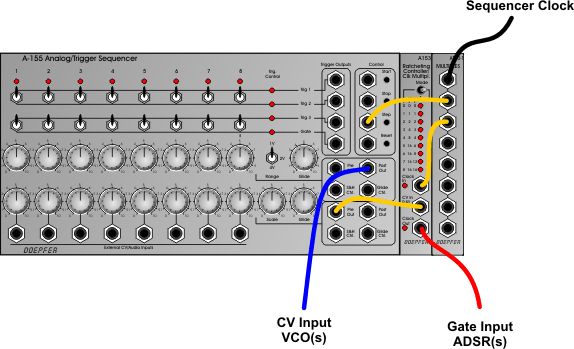
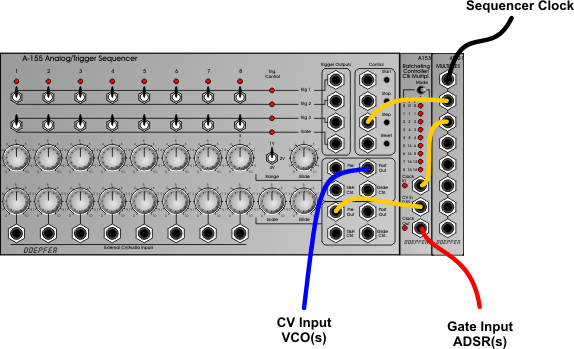
The module can be used for all kind of clock multiplying applications. One important example is the generation of so-called ratcheting sequences. The band Tangerine Dream is famous for this kind of sequences. A normal sequencer generates only one gate signal per step. A ratcheting sequence may have also more than one gate pulses per step. This function can be obtained by using the A-160-5: one CV output of the sequencer is used to define the number of gate pulses per step. If the control of the step in question is fully CCW the generated CV is 0V and no gate signal is generated (mute of the step). When the control of the step in question is turned clockwise one, two or more gate pulses are generated depending upon the position of the mode switch and the voltage generated by the CV at this step.
| Megvalósított funkciók | |
|---|---|
| CV source | Igen |
| Utility | Igen |
| Egyebek | |
| Gyártó | Doepfer |
| Szélesség (HP-ben) | 4 |
| Eurorack | Igen |